

The Used-EV Bargain Window Is Changing - Charging Economics Matter More Than Ever
The used-EV market continued to shift during this week. Affordable models that experienced steep depreciation are beginning to regain value, with the Chevrolet Bolt providing one of the clearest examples: data from recurring reports showed a 2023 Bolt EV increasing roughly 20% in value between January and June.
At the same time, charging economics continue to strengthen the case for drivers who can charge where they live. Kelley Blue Book's latest cost analysis concludes that overnight home charging is generally the least-expensive charging option, while public charging typically carries a premium.
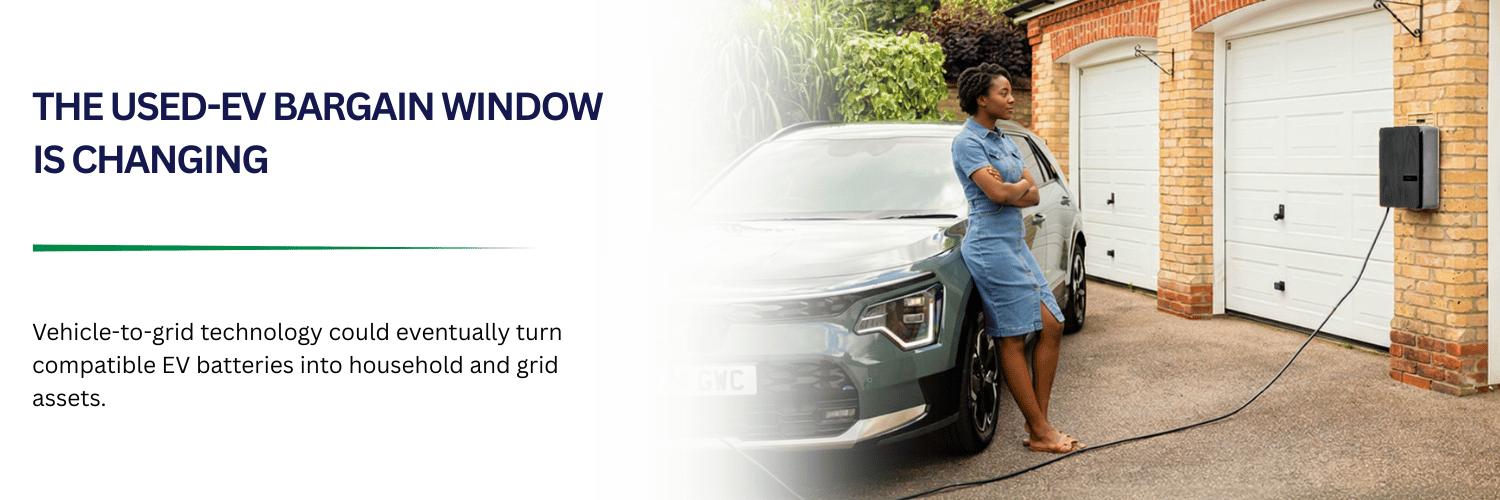
The bigger story, however, is that charging itself is evolving. Vehicle-to-grid technology could eventually turn compatible EV batteries into household and grid assets, while manufacturers are increasingly designing vehicles around multiple charging options and newer connector standards.
For the Used EV Buyer, this means the decision is becoming more sophisticated. Finding a discounted EV is no longer enough. The winning combination is the right used EV + healthy battery + appropriate charging capability + dependable @Home charging.
Top 10 Stories You Should Know About This Week
1. Used Chevrolet Bolt Prices Jump as Affordable EV Demand Strengthens
Used Chevrolet Bolt values are rising as demand strengthens for affordable pre-owned EVs. According to Recurrent data cited by GM Authority, the average value of a 2023 Bolt EV climbed from $17,718 in January to $21,204 in June—about a 20% increase—and the Bolt ranked among the fastest-selling used EVs.
Source: Used Chevy Bolt Prices on the Rise
2. Rivian R2 Shows Why Charging Curve Matters More Than Peak Charging Number
Independent testing of the new Rivian R2 highlighted strong charging performance despite its 400-volt architecture. For used-EV shoppers, the broader lesson is important: advertised peak kilowatts alone don't tell you how quickly a vehicle will complete a real charging session; the charging curve matters.
Source: The Rivian R2 Is a Charging Beast
3. Real-World Rivian R2 Efficiency Raises an Important Buying Question
Testing found differences between the Rivian R2's official efficiency rating and observed highway energy consumption. The lesson applies broadly to an EV Buyer scouring the previously-owned marketplace for a bargain. EPA range is useful for comparison, but a used-EV purchase should also consider highway speed, weather, wheels, climate control and the driver's actual commute.
Source: Something Doesn't Add Up About the Rivian R2's EPA Efficiency Rating
4. BMW Moves Ahead With U.S. Battery Production for Its Next EV Generation
BMW is preparing U.S. battery-pack production to support its upcoming iX5 and broader Neue Klasse strategy. Continued domestic battery investment matters to the future used-EV market because today's new vehicles become tomorrow's pre-owned inventory, while local manufacturing can improve parts, service and long-term product support.
Source: Inside BMW's Plan to Produce the iX5's Battery Pack in the U.S.
5. Mitsubishi Confirms Multiple Charging Options for Its New U.S. Eclipse EV
Mitsubishi confirmed that its upcoming Eclipse Sportback EV will support Level 1 and Level 2 AC charging through J1772 and DC fast charging through NACS. The vehicle will use a liquid-cooled 75-kWh battery, illustrating how automakers are designing newer EVs to bridge today's residential charging infrastructure with the industry's NACS transition.
Source: Mitsubishi Eclipse Sportback EV Charging Announcement
6. BMW iX3 Production Reaches 50,000 as EV Demand Exceeds Production
BMW produced its 50,000th iX3 only nine months after beginning production, while orders approached 100,000. Strong demand for newer-generation EVs demonstrates that consumers remain interested when range, efficiency, technology and charging performance align with expectations
Source: BMW Has Already Made 50,000 iX3s
7. Real-World Rivian R2 Highway Range Put to the Test
A highway test drove the Rivian R2 until its battery was depleted to evaluate how closely its real-world range matched expectations. Tests like these are especially valuable to future used-EV shoppers because actual highway performance may matter more than the EPA window sticker when deciding whether a particular battery size fits a driver's lifestyle.
Source: Rivian R2 Range Tested Until It Died
8. Solid-State Battery Developers Work on One of the Technology's Biggest Manufacturing Challenges
Factorial announced work with a Hyundai supplier aimed at overcoming manufacturing challenges associated with solid-state batteries. While this technology is not yet a reason for Marcus to postpone today's used-EV purchase, continued battery development points toward future vehicles offering greater energy density, potentially faster charging and improved performance.
Source: Factorial Tackles a Major Solid-State Battery Challenge
9. Vehicle-to-Grid Could Deliver Billions in Value From EV Batteries
A new E3 analysis commissioned by General Motors estimates that U.S. vehicle-to-grid integration could create approximately $7 billion in potential value by 2030. The study found that bidirectional charging could deliver five to 15 times more value per EV in many electricity markets than one-way managed charging.
Source: V2G Could Deliver 15 Times More Value Than One-Way Managed Charging
10. Home Charging Remains the Least-Expensive Way to Fuel an EV
Kelley Blue Book's updated charging-cost analysis reinforces one of the most important economic facts for Marcus: overnight residential charging is generally the least-expensive way to recharge an EV. Public stations can provide essential backup and road-trip capability, but their charging fees are typically higher than residential electricity rates.
Source: How Much Does It Cost to Charge an Electric Car?
Something important is happening in the used-EV market.
For several years, shoppers were told to wait because EV depreciation would continue creating better deals. Now some of the most practical affordable EVs are moving in the opposite direction.
The Chevrolet Bolt is a great example.
That means Marcus should stop thinking only about finding the cheapest EV and start looking for the best ownership value.
That calculation should include the purchase price, battery condition, real-world range, insurance, remaining warranty, Level 2 charging rate, DC fast-charging capability, connector type and the cost of installing charging at home.
A $20,000 used EV that fits your 40-mile daily routine and charges overnight at home may provide more practical value than a $30,000 EV with substantially more range you rarely use.
Buy the range you need. Build the charging solution that supports it.
Bought a used EV? Still planning your week around public charging? Looking for a practical way to make EV ownership easier?
The StayReady @Home Charging Package by Dai Technologies Corporation helps DMV homeowners transition to convenient overnight EV charging with certified installation, permitting support, and turnkey guidance designed around real life.
Because the best EV experience starts where you live.

Have questions? DaiTechCorp is here to help.
We’re certified, licensed, and code-smart. Let’s build your EV future the right way.
Connect with us www.linktr.ee/daitechcorpinfo