

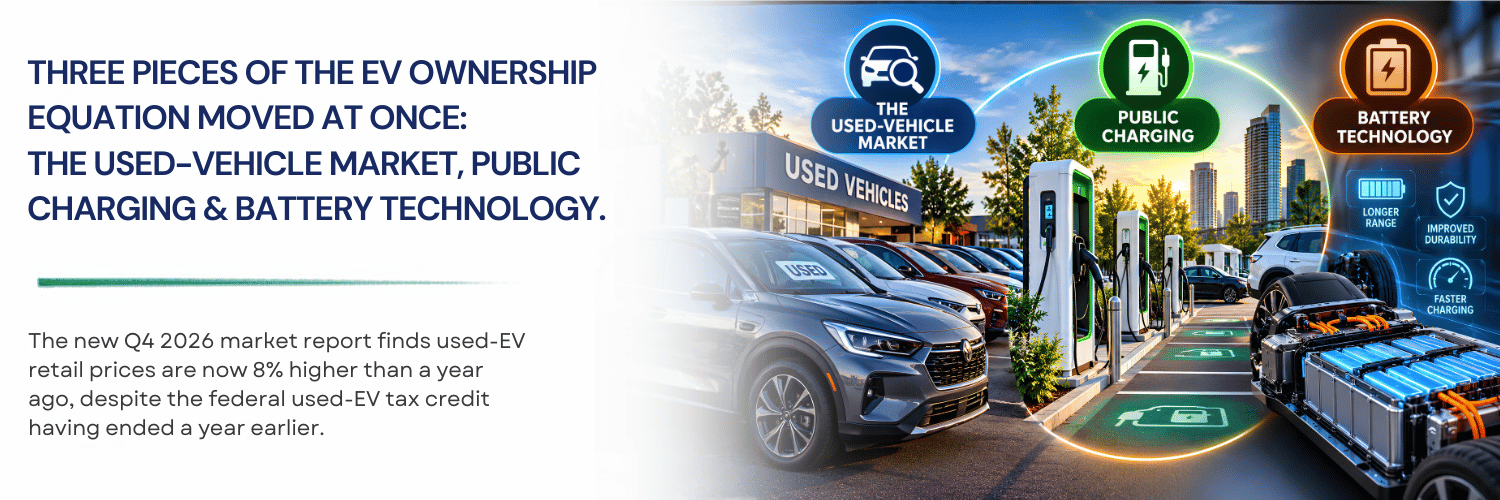
This was a particularly strong week because three pieces of the EV ownership equation moved at once: the used-vehicle market, public charging and battery technology.
Recurrent's new Q4 2026 market report finds used-EV retail prices are now 8% higher than a year ago, despite the federal used-EV tax credit having ended a year earlier. Supply is also increasing as 2023-model-year leased EVs begin returning to dealerships. Importantly, used EVs are now selling about as quickly as comparable gasoline vehicles.
Charging infrastructure delivered equally significant news. IONNA surpassed 180 live U.S. sites, more than doubling its network during 2026, while EVgo previewed a next-generation charging architecture capable of delivering up to 750 kW. A September 28 charging-data snapshot counted more than 304,000 public charging ports across the United States.
Meanwhile, GM and LG Energy Solution announced plans to retool their Tennessee battery facility for lower-cost lithium-manganese-rich battery cells.
The takeaway isn't that you should wait for tomorrow's technology.
It's almost the opposite:
The ecosystem around today's used EV is getting better while the vehicle itself gets cheaper than new.
Top 10 Stories You Should Know About This Week
1. Used-EV Prices Are 8% Higher Than a Year Ago
Recurrent's Q4 2026 market analysis finds used-EV retail prices are holding the gains they made earlier this year. Prices are approximately 8% higher year over year, although they have stabilized during recent months.
Source: Used Electric Car Prices & Market Report — Q4 2026
2. More Off-Lease EVs Are Reaching Used-Car Lots
EVs leased in 2023 are reaching their three-year return point, creating a growing stream of relatively young used vehicles. Recurrent describes these off-lease vehicles—often carrying modern technology and lower mileage—as an important affordability opportunity.
Source: Recurrent Q4 Used-EV Market Report
3. Used EVs Are Selling About as Quickly as Comparable Gas Cars
The maturation of the used market isn't merely about supply. Recurrent reports that used EVs are now moving at approximately the same speed as comparable gasoline vehicles, despite used EVs costing about 8% more on average.
Source: Recurrent Used-EV Sales Analysis
4. The Chevy Bolt Remains a Used-EV Hot Seller
Recurrent's June-through-September listing analysis puts the Chevrolet Bolt among the fastest-selling used EVs, with a median 13 days to sell and median price of $17,990. That combination helps explain why affordable, practical used EVs remain competitive even without the former federal used-EV incentive.
Source: Q4 Used-EV Model and Pricing Data
5. More Than 304,000 Public Charging Ports Appear in Latest Combined Dataset
SpotCharge's September 28 snapshot identified 70,975 charging locations and 304,156 ports across its merged public datasets. Of those locations, 17,517 offered DC fast charging. Because SpotCharge combines and deduplicates DOE/AFDC, OpenChargeMap and OpenStreetMap data, its count should be understood according to that methodology rather than treated as an official DOE-only total.
Source: U.S. EV Charging by the Numbers — September 28
6. IONNA More Than Doubles Its Network in 2026
Automaker-backed IONNA announced that it now operates more than 180 live charging sites nationwide, more than twice its footprint at the beginning of the year. More than 40 of those locations are Rechargeries at Circle K sites, while the network is also expanding roaming, Plug & Charge and automaker-discount integrations.
Source: IONNA Network Expansion Announcement
7. EVgo Previews Charging Up to 750 kW
EVgo unveiled a next-generation charging architecture designed to deliver up to 750 kW as future vehicle battery capabilities increase. Development and testing are underway at EVgo's California Innovation Lab with Delta Electronics supporting co-development.
Source: EVgo Next-Generation 750-kW Charging System
8. GM and LG Are Working on Lower-Cost EV Batteries
GM and LG Energy Solution plan to upgrade their Tennessee joint-venture battery facility to manufacture lithium-manganese-rich prismatic cells. The technology is intended to reduce battery costs for future GM electric vehicles while retaining competitive performance.
Source: GM and LG Plan Lower-Cost EV Battery Production
9. Toyota Opens a New North American Battery Center
Toyota opened a 30,000-square-foot Battery Center of North America in Saline, Michigan, creating a dedicated facility for evaluating and developing battery technologies for North American manufacturing and electrified vehicles. It is another indication that battery expertise is becoming a permanent part of the U.S. automotive ecosystem.
Source: Toyota Opens Battery Center of North America
10. Utility Charging Incentives Remain an Important Part of the Ownership Equation
Even as federal vehicle and residential charging tax credits have expired, DOE's Alternative Fuels Data Center continues to identify numerous utility programs supporting EV charging. Its current database lists 114 participating utilities/private entities offering Level 2 charger-purchase rebates, illustrating why we should investigate local utility programs rather than assuming incentives have disappeared altogether.
Source: AFDC Utility EV Charging Incentives
There's a sentence in this week's Recurrent report that should get every used-EV buyer's attention:
The market survived the loss of the federal used-EV credit.
A year ago, that incentive could be worth as much as $4,000 to an eligible buyer.
It's gone.
Yet used-EV prices are up from last year.
Sales are growing.
Supply is growing.
And good used EVs are moving.
So here's what I would not do:
Wait indefinitely because somebody told me EV technology is changing too quickly.
Of course it's changing.
EVgo is already talking about 750-kW charging.
GM is developing different battery chemistry.
Charging networks are expanding.
But here's the question that matters:
Do I need tomorrow's technology to handle today's commute?
If I find a healthy $18,000 used EV that comfortably handles my driving and I can reliably charge it overnight at home, the fact that a future EV may charge dramatically faster doesn't automatically make today's vehicle a bad purchase.
Buy for your use case—not the technology headline.
Bought a used EV? Still planning your week around public charging? Looking for a practical way to make EV ownership easier?
The StayReady @Home Charging Package by Dai Technologies Corporation helps DMV homeowners transition to convenient overnight EV charging with certified installation, permitting support, and turnkey guidance designed around real life.
Because the best EV experience starts where you live.

Have questions? DaiTechCorp is here to help.
We’re certified, licensed, and code-smart. Let’s build your EV future the right way.
Connect with us www.linktr.ee/daitechcorpinfo