

Used EV Supply Is Growing—and Buyers May Be Regaining Some Negotiating Power
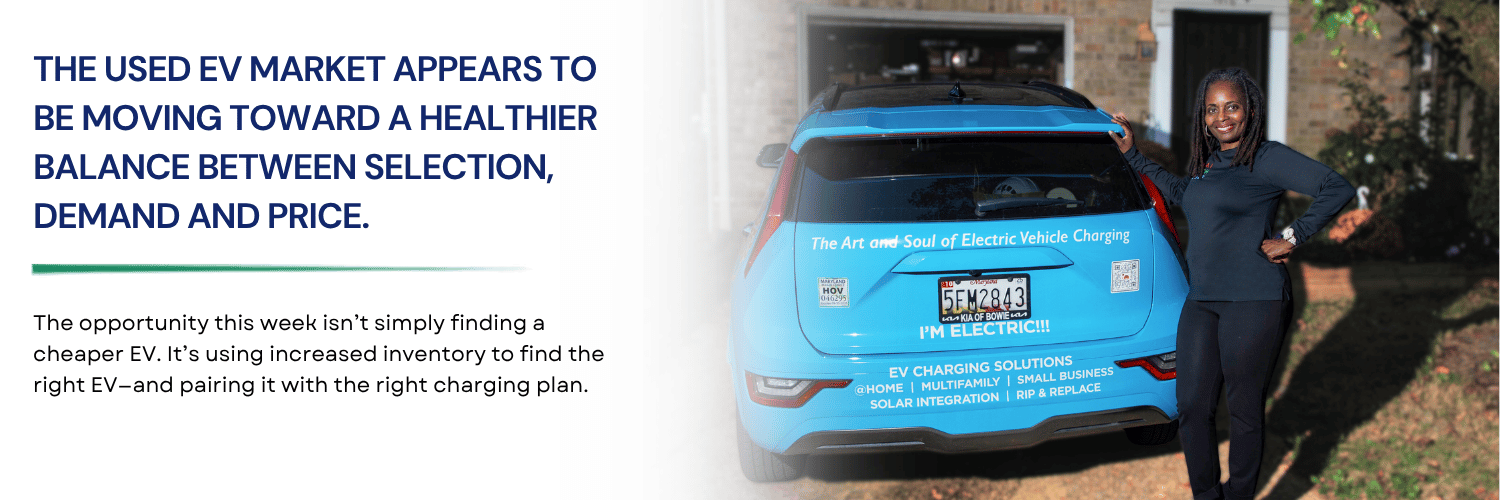
This week brings an important development: the used-EV market appears to be moving toward a healthier balance between selection, demand and price.
Cox Automotive’s July EV Market Monitor shows 36,810 used EVs sold in July, up 7.9% from June and 10.1% year over year. Used-EV inventory increased as off-lease vehicles and trade-ins reached dealers, while days’ supply rose to 46. At the same time, the average used-EV listing price eased from June but remained 8.3% above a year ago.
Then came another potentially significant signal: Cox’s mid-August wholesale data showed EV values falling 4.2% from July, despite remaining 5% higher year over year.
That combination deserves attention. More inventory plus moderating wholesale prices could create better opportunities for prepared buyers—even though the exceptionally cheap used-EV environment of previous years has not returned.
Meanwhile, the economics of charging remain compelling. Kelley Blue Book’s newly updated analysis again concludes that overnight @Home charging is generally the least-expensive charging option, while AAA’s current data put the national average for commercial/public charging at about $0.424/kWh as of August 28.
The opportunity this week isn’t simply finding a cheaper EV. It’s using increased inventory to find the right EV—and pairing it with the right charging plan.
Top 10 Stories You Should Know About This Week
1. Used-EV Sales Rise 10.1% Year Over Year
Cox Automotive reports that U.S. used-EV sales reached 36,810 vehicles in July, increasing 7.9% from June and 10.1% from July 2025. Tesla continued to lead used-EV volume, while Ford, Chevrolet, Nissan and Cadillac also contributed to growth.
Source: Cox Automotive
2. Used-EV Inventory Expands as Lease Returns Reach Dealers
Growing off-lease returns and trade-ins pushed used-EV days’ supply to 46 days in July, up 14.6% from June. Ford carried 63 days of supply, Rivian 54 and Tesla 38, suggesting that negotiating conditions can differ substantially by manufacturer and model.
Source: Cox Automotive
3. Used-EV Listing Prices Ease From June
The average used-EV listing price reached $37,832 in July, down 1.2% month over month but still 8.3% higher than a year earlier. Cox attributes some of the elevated year-over-year price to newer-generation EVs entering the used market.
Source: Cox Automotive / Kelley Blue Book
4. Wholesale EV Values Fall 4.2% in the First Half of August
Cox Automotive’s Manheim data provide a new signal for buyers: wholesale EV values declined 4.2% from July during the first half of August. Values remained 5% higher year over year, but the monthly decline follows sustained appreciation earlier in 2026 and could eventually influence retail pricing.
Source: Cox Automotive
5. July Used-EV Sales Outpace Broader Market Growth
The National Independent Automobile Dealers Association highlighted July’s used-EV growth as an important opportunity for dealerships. NIADA cited the same 36,810-unit market, noting that supply and consumer interest both increased as higher gasoline prices strengthened the EV ownership calculation.
Source: NIADA
6. Dealers Are Beginning to Treat Used EVs as a Larger Business Opportunity
CDK Global reports that affordability and increasing lease returns are making pre-owned EVs more attractive to dealers and consumers. In its latest EV-owner research, 64% said they would consider a used EV for their next purchase, while 90% said they intended to purchase another EV.
Source: CDK Global
7. Home Charging Remains the Lowest-Cost Charging Strategy
Kelley Blue Book’s newly updated charging-cost analysis concludes that charging overnight at home is generally the least-expensive way to replenish an EV. Public charging remains important for travel and backup, but its per-kWh cost is typically higher.
Source: Kelley Blue Book
8. Public EV Charging Averages About 42¢ per kWh Nationally
AAA’s EV charging tracker reported a U.S. average commercial/public charging price of approximately $0.424 per kWh on August 28. Prices vary substantially by state: Maryland averaged roughly $0.348/kWh, Virginia $0.432/kWh, and Washington, D.C., $0.400/kWh.
Source: AAA
9. Public Charging Availability Continues to Expand
PlugShare’s August 26 directory illustrates the scale of public charging now available across the country. Its database listed particularly large charging footprints in California, New York, Texas and Florida, while the DMV also showed thousands of charging locations and ports available to drivers.
Source: PlugShare
10. Lucid Recalls More Than 27,000 Air EVs
Lucid is recalling 27,185 Air sedans in the United States because an exterior-lighting electrical circuit can potentially overheat, creating a fire risk, according to NHTSA. The development reinforces a basic rule for Marcus: before buying any used EV, run the VIN through NHTSA’s recall database and confirm that outstanding recall work has been completed.
Source: Reuters / NHTSA
I’ve been telling you for several weeks that used-EV prices were strengthening.
Now we’re getting another signal.
Inventory is growing.
And wholesale EV values softened considerably during the first half of August.
That doesn’t mean every dealer is suddenly discounting EVs.
But it does mean Marcus should start paying closer attention to days on the market, dealer inventory, and comparable vehicles nearby.
Here’s how I’d approach it:
Find three examples of the EV you want.
Compare model year, mileage, battery health, remaining warranty, and equipment.
Then compare prices.
And don’t forget the expense that isn’t on the dealer’s window sticker:
Charging.
A $1,000 discount on the vehicle doesn’t help much if you discover afterward that your home requires several thousand dollars of unexpected electrical work.
Shop the EV and investigate the charging installation at the same time.
That’s how you should negotiate the whole ownership experience, not just the vehicle.
Bought a used EV? Still planning your week around public charging? Looking for a practical way to make EV ownership easier?
The StayReady @Home Charging Package by Dai Technologies Corporation helps DMV homeowners transition to convenient overnight EV charging with certified installation, permitting support, and turnkey guidance designed around real life.
Because the best EV experience starts where you live.

Have questions? DaiTechCorp is here to help.
We’re certified, licensed, and code-smart. Let’s build your EV future the right way.
Connect with us www.linktr.ee/daitechcorpinfo